


Warning

What is the Spinal Cord?  

The spinal cord is the part of your central nervous system that transmits messages between your brain and your body. It resembles a cable which is about the thickness of your little finger and is approximately 52cm long. It begins at the base of the brain and runs through the spinal canal inside the spine, ending behind the 1st lumbar vertebra. At this point it becomes a bundle of nerves called the Cauda Equina which continues to run within the spinal canal. These nerves supply the legs, bladder, bowel and sexual organs.

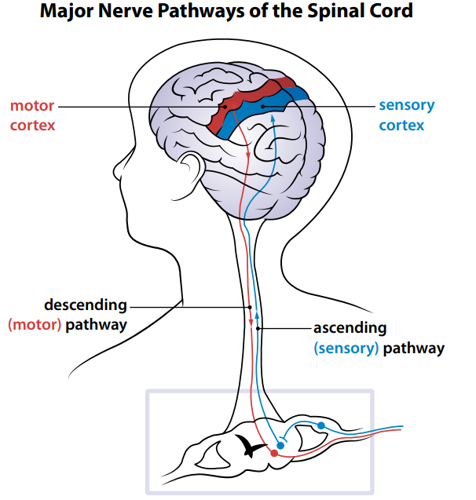
The spinal cord has two major nerve pathways that help your brain control your body:  

  1. Motor Nerve (descending) Pathway 

This carries information from the brain downwards to initiate movement and control body functions. Any damage to the motor nerve pathways within the spinal cord will result in the brain not being able to initiate movement and control within the body below the damaged site. This is known as paralysis.  

  1. Sensory Nerve (ascending) Pathway 

This carries sensory information from the body upwards to the brain such as touch, skin temperature and pain. If the sensory nerve pathways are also damaged, then the brain cannot feel the body below the damaged area. 
The Spine and Spinal Nerves 

To protect them from the risks of everyday life, the brain is protected by the skull and the spinal cord is protected by the spinal column. However for everyday activities we need our spine to be very flexible, allowing twisting and bending to occur. This is made possible by the spinal column being made up of 33 individual bones called vertebrae and 31 pairs of nerves.  

A diagram showing the spine. It is a side profile view indicating the sections of the spine. From top to bottom these are the Cervical Spine (Lordosis), Thoracic Spine (Kyphosis) and the Lumbar Spine (Lordosis). At the bottom of the spine, the Sacrum and Coccyx are indicated.Copyright: Wikimedia Commons

The vertebrae are divided into regions:

Cervical 7 vertebrae and 8 pairs of nerves that serve the arms
Thorax 12 vertebrae and 12 pairs of nerves that serve the torso 
Lumbar 5 vertebrae and 5 pairs of nerves that serve the upper and anterior (front) sections of the legs  
Sacral 5 vertebrae and 5 pairs of nerves that serve the posterior (back) section of the legs, the bowel and the bladder  
Coccygeal 4 vertebrae and 1 pair of nerves  

Each vertebra is separated by disc or cartilage. These discs act as shock absorbers and prevent the vertebrae from grinding together. The higher the spinal injury the more muscles become paralysed.  

Spinal Cord Injury

A Spinal Cord Injury (SCI) occurs when the spinal cord is damaged following trauma, due to a variety of causes. In the majority of cases the cord is crushed, which destroys nerve cells and nerve tracts (or pathways) at that specific level within the cord. This prevents or alters signals passing through the cord and results in paralysis and sensory changes. The level of injury is the exact point in the spinal cord at which damage has occurred, and anything that is below that level is affected.  

There are two broad types of spinal injury:

Tetraplegia: The spinal cord has been damaged in the cervical region (neck) and all four limbs are affected.  

Paraplegia: The spinal cord has been damaged below the level of T1. The legs are paralysed, and depending on the injury also the trunk. This does not affect the hands and arms.  

Spinal cord injuries are classified as either complete or incomplete:

Complete:  This means there is a complete loss of movement and feeling below the level of the injury. There are no messages getting past the area of damage. This is often a result of a significant trauma to the spinal column, such as a complete dislocation or a 3 column fracture to the vertebra. These types of injuries cause the spinal cord to be crushed and completely compromised.

Incomplete: This means there is some voluntary contraction of the anal ring and/or some deep anal sensation. This is often accompanied by some voluntary movement and sensation within the limbs below the spinal cord injury level. Only part of the spinal cord has been damaged and some messages are getting through. There are several types of incomplete injuries, and your team will explain the impact of these to you in more detail: 

  • Central Cord Syndrome 
  • Anterior Cord Syndrome 
  • Brown Sequard Syndrome 
  • Posterior Cord Syndrome 
  • Conus Medullaris Syndrome 
  • Cauda Equina Syndrome

Recovery after Spinal Cord Injury

Unlike other body systems, the spinal cord cannot regenerate or repair itself after injury. For those with incomplete injuries there is often improvement in power and sensation in the months after injury as swelling in the cord comes down and more signals can pass. Recovery is not predictable, and it is not currently possible to know at the time of injury how much improvement will occur after damage to the cord.

For those with complete injuries, it is often the case that even when the swelling has resolved, signals are still unable to pass the damaged area of cord. Because of this, power and sensation do not return, although there may be some improvement in the few levels below the original injury. A small percentage of people who present with a complete injury will regain some sensation and power. Again, it is not possible to accurately predict the extent of this recovery.

Editorial Information

Last reviewed: 30/09/2024

Next review date: 30/09/2028

Author(s): Editorial Group QENSIU .

Version: V1

Co-Author(s): louise.cownie@nhs.scot , campbell.culley2@nhs.scot , mary.hannah@nhs.scot , susan.gilhespie2@nhs.scot , claire.lincoln2@nhs.scot .

Reviewer name(s): Mary Hannah.